

You've got plants.
But do you have a
Big Guy?
_JPG.jpg)
_JPG.jpg)

_JPG.jpg)
Purple False Eranthemum
(Pseuderanthemum carruthersii var. atropurpureum)
Come Get Your Big Guy!!
Chicago PlantCon June June 20–21, 2026
Donald E. Stephens Convention Center
_JPG.jpg)
_JPG.jpg)
_JPG.jpg)
About Big Guy
_JPG.jpg)
_JPG.jpg)


Who is Big Guy?
This plant was gifted to me by my soon-to-be Husband back in 2000. It was just a little guy, a total mystery as to what it was, but I, Lacey, fell in love with it. It got the nickname "Big Guy" and our journey together began.
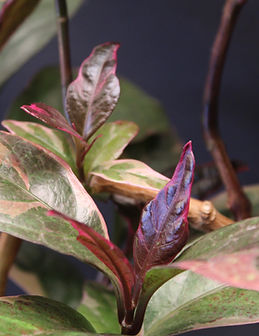
This plant is a soft-wooded upright shrub from the South Pacific region and can reach heights of over 15 ft. It has striking foliage that begins with shades of purples and pinks fading to green with streaks of creams. Older leaves will turn yellow and fall off naturally. The flowers are small clusters of pink, rose-purple, or white with purple markings.
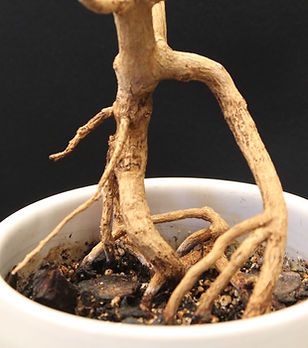
Each Big Guy is taken as a cutting from #1 . Big Guy's #2, 3, 5, and 6 are 20 years old, and #7 is 5 years old. Each cutting is designated by who they come from (excluding #4 which didn't make it) and then a letter. Some lettered plants haven't made it, and I retire those letters from use. Each plant has a unique Nebari that take 1-2 years to form. Some plants I see the shape they are going to take right from the start. Others vex me in what form they are supposed to take, and I love that too.
I look forward to sharing my Big Guys with the world. I want to make more, but I have no more space for plants. So it's time for these Big Guys to find new friends. And when you meet him, please be nice and say:
"Well Hello Big Guy. My goodness you're looking beautiful today."
_JPG.jpg)
Living Sculptures
Shaped by Time
Care Guide
Light: Medium to High light
*Currently grows under Monios-L Led Grow Lights for Indoor Plants Full Spectrum,T8 2FT 144W - 3 on each level with a 12-hour on/off cycle.
Water Keep the potting mixture moist, but plant can tolerate some drying. Limp leaves can indicate an immediate need for water.
Humidity: Average (25% or more)
Fertilization: Apply fertilizer as indicated by the manfucturer. This plant loves a regular feeding schedule.
Propogation: Tip cuttings of 2 to 4 inches with 4 or more leaves.
Potting Mix: Chunky soil mix with addition of perlite and bark to create air pockets in the soil. Repot every 1-2 years when young. Repot every 5-10 years with mature plant. A heavy pot is highly recommended as the plant tends to become top-heavy.
Care tips: The plant will become leggy over time as it reaches for the light. Regular pruning will promote branching and a healthy, thick trunk.
Insects: will love this plant as much as you do. Fungus gnats can become an issue, as this plant prefers to have moist soil. Thrips and spider mites love the nooks and crannies. Be on the lookout for scale, and at the first sign of honey dew on leaves get out your magnifying glass and find them. They should be removed with a q-tip dipped in alcohol. Check the entire plant for hidden ones. Regular application of a systemic houseplant insect control is strongly advised. Regular showers help to keep bugs from making homes along with washing dust off. When needed, I highly reccommend spraying with the insecticide Atticus Spliven, making the mixture fresh every time, and completely soaking the plants. This, along with the granular systemic, keeps most pests away.